
Why Co Packaged Optics Is Back and Why It Matters More Than Ever
Why Co-Packaged Optics Is Back—and Why It Matters More Than Ever
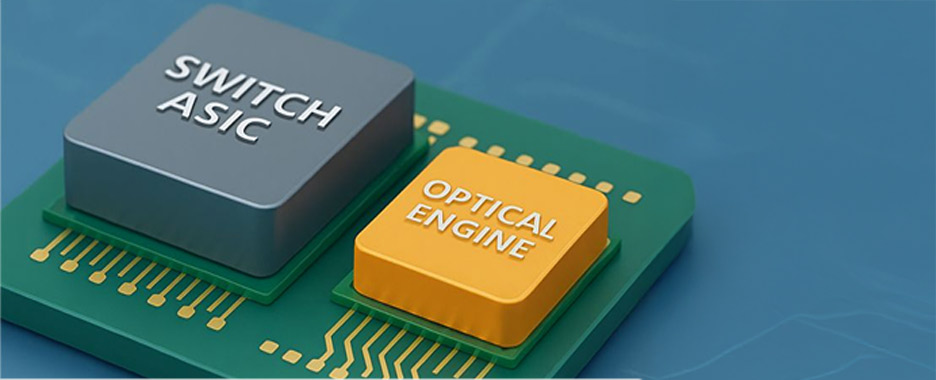
For years, the race for faster networks was driven by better silicon. Smaller transistors, higher clock speeds, and denser logic kept pushing performance forward. But today, something else is becoming the bottleneck—and the industry is finally addressing it head-on. Co-Packaged Optics (CPO) is back, and this time, it’s not a science project. It’s a necessity.
In traditional switch architectures, data travels a surprisingly long electrical journey before it ever becomes light. Signals move from the switch ASIC, across the package, through the PCB, into pluggable optical modules at the edge of the system. At lower speeds, this worked well enough, but at today’s speeds of 51.2T, and soon 102.4T switches, it doesn’t.
That long electrical path comes at a steep cost. Signal integrity degrades over distance, forcing designers to burn more power in SerDes to compensate. Latency creeps up. Thermal budgets get tighter. And as bandwidth scales, these problems don’t grow linearly—they compound.
CPO flips this model entirely.
Instead of pushing high-speed electrical signals across inches of copper, CPO brings the optical engine right next to the switch ASIC. The electrical path shrinks from centimeters to millimeters. Data is converted to light almost immediately, before losses and noise can take their toll.
- Lower SerDes power, because signals no longer need heavy equalization
- Higher bandwidth density, enabling scale beyond the limits of pluggable optics
- Cleaner signal integrity, even at extreme data rates
- Lower latency, critical for AI training and inference fabrics
In short, collapsing the last electrical mile unlocks performance that silicon alone can no longer deliver.
Of course, CPO is not without challenges. Thermal co-design, serviceability, optical alignment, and manufacturing complexity are all real hurdles. That’s why adoption is happening in phases. Near-term deployments often rely on bridge approaches such as Near-Packaged Optics (NPO) or On-Board Optics (OBO), which shorten electrical paths without fully committing optics into the package.
But the direction of travel is clear.
As AI clusters grow larger and faster, networks must move vast amounts of data with minimal power and latency overhead. In these environments, the traditional separation between compute, packaging, and optics breaks down. The package becomes part of the system architecture—and optics becomes a first-class design constraint.
CPO represents more than a packaging innovation. It’s a signal that the industry has entered a new era, where performance is defined not just by what happens inside the die, but by how efficiently data exits it.
For next-generation networks, the question is no longer if the electrical mile must collapse—but how fast the ecosystem can make it happen.
Blog Titles